-
 play_arrow
MIX 56 CHESHIRE'S BEST MUSIC MIX

Review: Who’s Afraid of Virginia Woolf
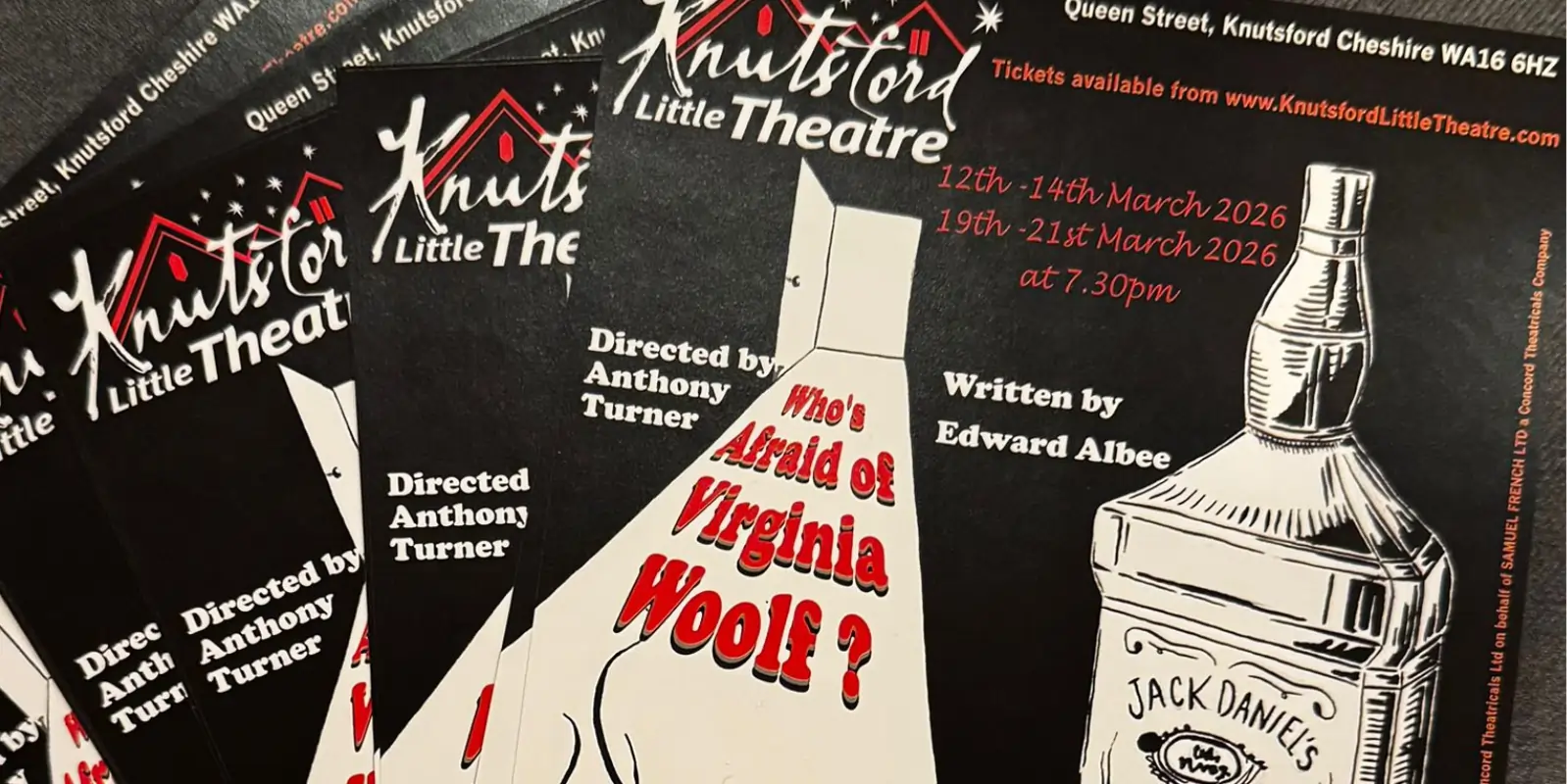
Review: Who’s Afraid of Virginia Woolf at Knutsford Little Theatre
Stefan Wilkinson- Hill
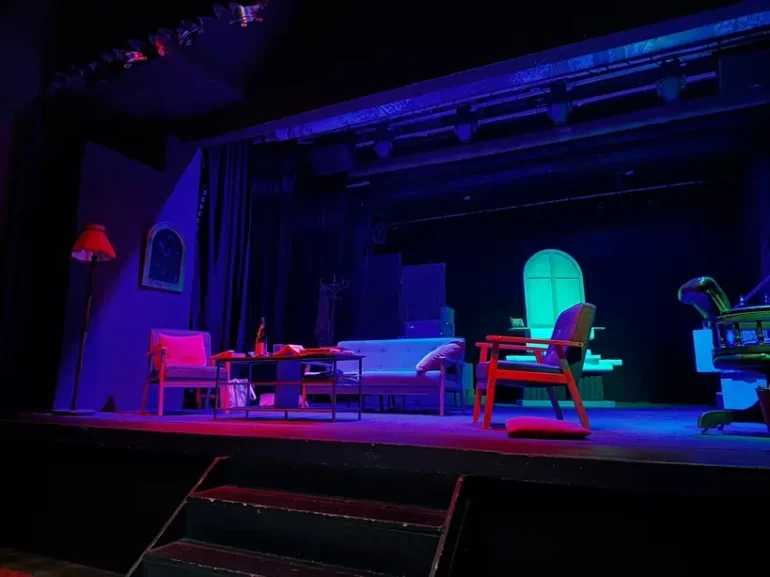
Knutsford Little Theatre is an intimate venue; one entirely suited to the production of Who’s Afraid of Virginia Woolf? written by Edward Albee. Walking into the theatre, the immersion was already in full swing, with soft jazz music piped in through the speakers, and the homely living room set laid out before us.
Before the actors stepped upon the stage, I found myself already impressed by the attention to detail.
A small set of chairs with a 60s coffee table set in the middle – open books, a glass ashtray, and a lighter lying upon it. In the corner, a beautiful wooden desk and chair brilliantly evoked the academic setting in which we found ourselves – you really did feel as if you were being invited into the living room of an aging academic couple.
Even down to the pile of books and crumpled papers at the base of the typewriter-topped table, the set felt deliberate without feeling contrived. The bar at the back of the set was an omen of things to come.
The lights went down and in stumbled George (John Smethurst) and Martha (Kate Henry), George a history professor with waning ambition and a sizable chip on his shoulder, and Martha, the daughter of the university president, armed with a vicious tongue and a love of ‘the games’.
The dynamism and chemistry between the pair was excellent.
‘Every relationship goes through rocky periods – George and Martha have made a fetish of these things’ Anthony Turner (Director)
You really do feel you have met this couple before, be it Jan and Michael in the Office, Harry and Sarah in Company, or dare I say the couple from down the road? Throughout the play, the two continued to bounce off – or rather slam against – one another, with both Henry and Smethurst playing brilliantly the complex mix of cruelty, venom, and ultimately a masked tenderness between them.
‘There is definitely a tenderness that underlies all of it. And you do see glimpses of that throughout it as well’ Kate Henry (Martha)
Honey (Emily Yendell) and Nick (Edward Watterson) are the younger couple, and for the most part in the opening of the play, they act as the audience surrogates.
The staging of these first few scenes was entertaining, with the younger sitting between the older couple, like umpires watching a tennis match, their two heads turning back and forth from George to Martha to George to Martha, as the insults flew across the room with the speed of an ‘Alcarazian’ serve.
The alcohol was flowing throughout the play: bourbon and brandy all allowing for entertaining, yet well-restrained performances of increasing inebriation, as the cast (Honey particularly) went from tipsy to markedly ‘sloshed’.
It is here where I must commend the subtle but rapturously humorous performance of Yendell, who demonstrated the full breadth of her acting capabilities, playing both a convincing giggly drunk (I often think it is hard to portray drunkenness without slipping into the ridiculous) and the biting emotional rawness on display in the final act.
A cork popping off an alcohol bottle (though whether this was a deliberate inclusion) in the first act humorously punctuated the often vulgar and shocking nature of the dialogue.
‘(Albee) is one of the finest 20th century American playwrights… his prose style is an absolute joy’ Anthony Turner (Director)
The play hangs on its dialogue – it is famous for it.
And the cast were clearly well familiar with the text, allowing for the witty rapport to bounce along in a breezy way that meant the run time of the play flew by.
The quick interchanges of dialogue were for the most part really well executed with only one slightly trickier moment as the music of an on-stage record player slightly obscured the dialogue for a brief moment in the second act.
The play came to an emotional climax in the third act with a wicked combination of Latin verse, tears freely flowing, and illusions finally shattered on all sides.
As the play ended with a brilliant lighting cue, the audience sat for a moment in the silence – contemplating what we had just watched.
The best art is that which allows you to learn something about yourself as much as about the characters you are watching, and I would hasten to bet that there were a fair few couples sitting in the Little Theatre, feeling personally challenged and addressed by the brutal domesticity of the play, aware entirely of the intimacy of the venue as the lights went down and the play came to a cathartic close.
‘This is going to help your relationship if you’re a couple’ John Smethurst (George)
It isn’t often I am lost for words – I am in the business of ‘talking’ for a living! But as I walked away from the Little Theatre, I was content to be left in the silence of my own thoughts.
Thinking over both the shocking picture of married life the play portrays, but also the masterful way in which all four actors fully embodied their characters, and presented a viscerally emotional performance.
Listen Again
Prior to the performance, Stefan caught up with some of the cast for the Phil in the Morning show. You can listen again to the conversations right here.
-
 play_arrow
Review: Who’s Afraid of Virginia Woolf Part 1
-
play_arrow
Review: Who’s Afraid of Virginia Woolf Part 2
-
play_arrow
Review: Who’s Afraid of Virginia Woolf Part 3